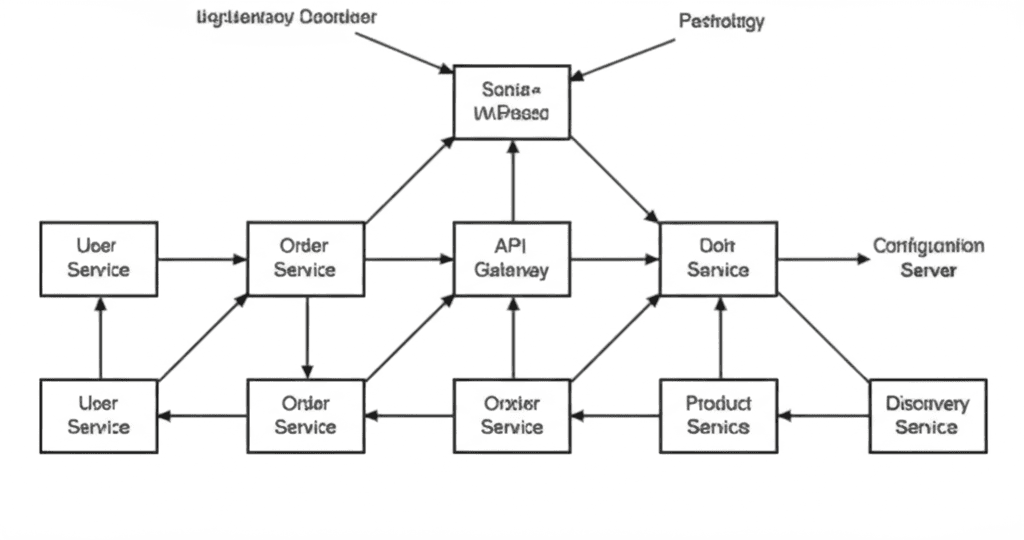
Microservices architecture has become the de facto standard for building scalable, maintainable enterprise applications. However, the transition from monolithic to microservices is fraught with challenges that many organizations underestimate. After implementing microservices architecture for over 50 clients across diverse industries, our team at Bitropix has accumulated a wealth of practical knowledge. This article distills our most important lessons into actionable guidance.
When to Use Microservices (And When Not To)
Not every application needs microservices. If you are building a simple CRUD application with a small team, a well-structured monolith will serve you better. Microservices add complexity in deployment, monitoring, debugging, and inter-service communication. They make sense when you have a large team that needs independent deployment cycles, when different parts of your system have vastly different scaling requirements, or when you need technology diversity across services.
- Good fit: Large teams, complex domains, high-scale requirements, polyglot technology needs.
- Poor fit: Small teams, simple applications, tight deadlines, limited DevOps maturity.
Domain-Driven Design Is Essential
The biggest mistake we see is splitting services along technical boundaries instead of business domains. A "database service" or "authentication service" that every other service depends on creates a distributed monolith with all the downsides and none of the benefits. Instead, use Domain-Driven Design (DDD) to identify bounded contexts. Each microservice should own a specific business capability, its data, and its logic. When in doubt, start with a larger service and split later when clear boundaries emerge.
API Design and Communication Patterns
Synchronous vs. Asynchronous Communication
Choose your inter-service communication patterns carefully. Synchronous REST or gRPC calls are simple but create tight coupling and cascade failures. Asynchronous messaging through event brokers like Kafka or RabbitMQ provides better decoupling and resilience. In practice, most systems use a mix of both. Use synchronous communication for queries that need immediate responses and asynchronous communication for commands and events.
API Versioning and Contracts
Establish API versioning from day one. Breaking changes in a microservices environment can cascade through the entire system. Use consumer-driven contract testing to ensure API compatibility. Maintain backward compatibility whenever possible, and when breaking changes are unavoidable, use deprecation periods to give consuming teams time to adapt.
Data Management in Microservices
Each microservice should own its data and never directly access another service's database. This principle, known as database-per-service, ensures loose coupling and independent deployability. Use the Saga pattern for distributed transactions, event sourcing for audit trails, and CQRS (Command Query Responsibility Segregation) when read and write patterns differ significantly. Accept eventual consistency as the default and design your UI accordingly.
Observability: Logging, Tracing, and Metrics
In a microservices environment, a single user request might traverse dozens of services. Without proper observability, debugging issues becomes nearly impossible. Implement the three pillars of observability from the start.
- Structured logging: Use consistent log formats with correlation IDs that span service boundaries.
- Distributed tracing: Tools like Jaeger or Zipkin visualize request flows across services.
- Metrics and alerting: Monitor latency, error rates, and throughput for every service using Prometheus and Grafana.
Deployment and Infrastructure
Microservices demand robust CI/CD pipelines and infrastructure automation. Each service should have its own pipeline capable of independent building, testing, and deployment. Kubernetes has become the standard orchestration platform, providing service discovery, load balancing, and self-healing. Invest in infrastructure-as-code using Terraform or Pulumi, and use GitOps workflows for deployment management.
Conclusion
Microservices are a powerful architectural pattern, but they require significant investment in tooling, processes, and team skills. Start small, invest in automation, and always let business requirements drive your architectural decisions. At Bitropix, we help organizations navigate the microservices journey, from initial architecture design through implementation and ongoing operations.
Vikram Patel
Senior Frontend Developer
Vikram Patel is a member of the Bitropix team, contributing insights on development and related topics. With deep industry experience, they help businesses navigate technology challenges and drive innovation.